 Get a free draft
NilaWorks builds websites for dental clinics, diagnostic labs and specialist practices in Chennai — the page a patient actually reads before they pick up the phone. Fixed price, no meetings, first draft free.
A good practice can be nearly invisible online and never know it — because the directories look busy, and busy feels like presence.
Most practices we looked at are findable only through Practo, JustDial or Lybrate tiles. Those platforms control the ranking, the layout, the leads and the phone number shown — and they rent the same space to the clinic three streets away.
The same practice routinely appears across directories under slightly different names, old addresses and disconnected numbers. Every wrong number is a patient who tried once and moved on — and you never hear about it.
Search the doctor's name and you land on one page; search the clinic and you land on another. A patient recommended by a friend often can't confirm they're the same place — so the referral quietly dies at the search box.
Implants, maxillofacial surgery, a diagnostic panel — people research these for weeks. They want to know how it's done, what it costs, what recovery looks like, who's doing it. If there's nothing of yours to read, they read someone else's.
Not "look modern". These are the five things that decide whether a patient calls you or the next result.
Nobody searches for your clinic's name until they already know it. They search “root canal in Velachery”, “blood test near Medavakkam”, “ENT doctor Anna Nagar”. Your pages should be built around those exact phrasings, in plain English, with the locality on the page.
Your patient is on a four-year-old Android in a queue with two bars of signal. We ship lean pages — no heavy page builders, no eight tracking scripts. If it doesn't paint in a couple of seconds, it doesn't exist.
One number, one address, one clinic name — identical on the site, on Google Business Profile and on every directory you're listed in. This is the single cheapest fix most practices have never made.
Tap-to-call and WhatsApp buttons that are always in reach, plus a short enquiry form for people who won't call. No login. No 12-field form. No “we'll get back to you” black hole.
Will it hurt. How many sittings. Roughly what will it cost. Do you take my report from another lab. Is there parking. Practices answer these on the phone forty times a week — the site should answer them once, calmly, in writing.
Read this before you click. Every page below is a speculative concept — we picked a real Chennai practice we could see had a gap, built a page for it on our own time, and nobody paid us or approved it. Names, timings, prices and phone numbers on those pages are placeholders for demonstration. They are not official sites, they are not endorsed by the practices, and we have no healthcare clients yet. Each page carries that notice at the top of it too.
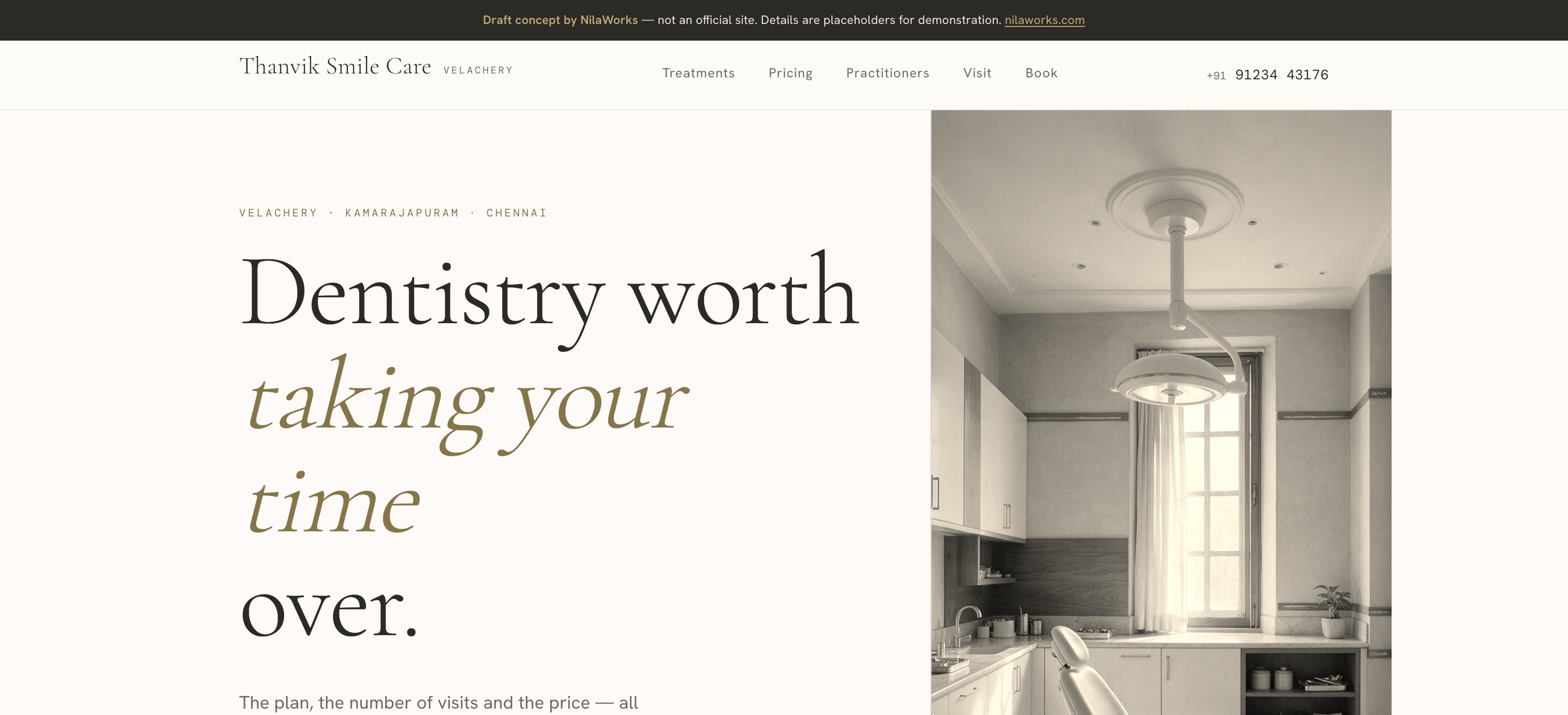
A well-reviewed dental practice whose only presence was directory tiles. The problem we set out to solve: treatment costs that patients ask about anyway, published up front in warm sand and gold, so price stops being an awkward phone call.
Open the concept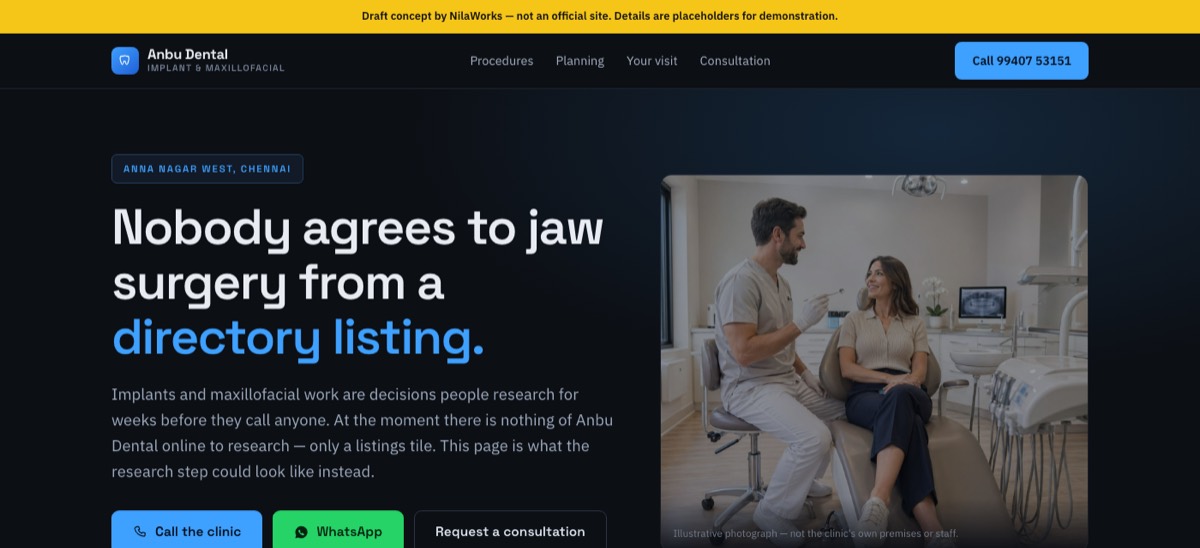
Nobody agrees to jaw surgery from a directory tile. The problem: the highest-consideration treatment in dentistry had the least material to research, so this page walks through planning, the procedure and recovery in the order a worried patient asks about them.
Open the concept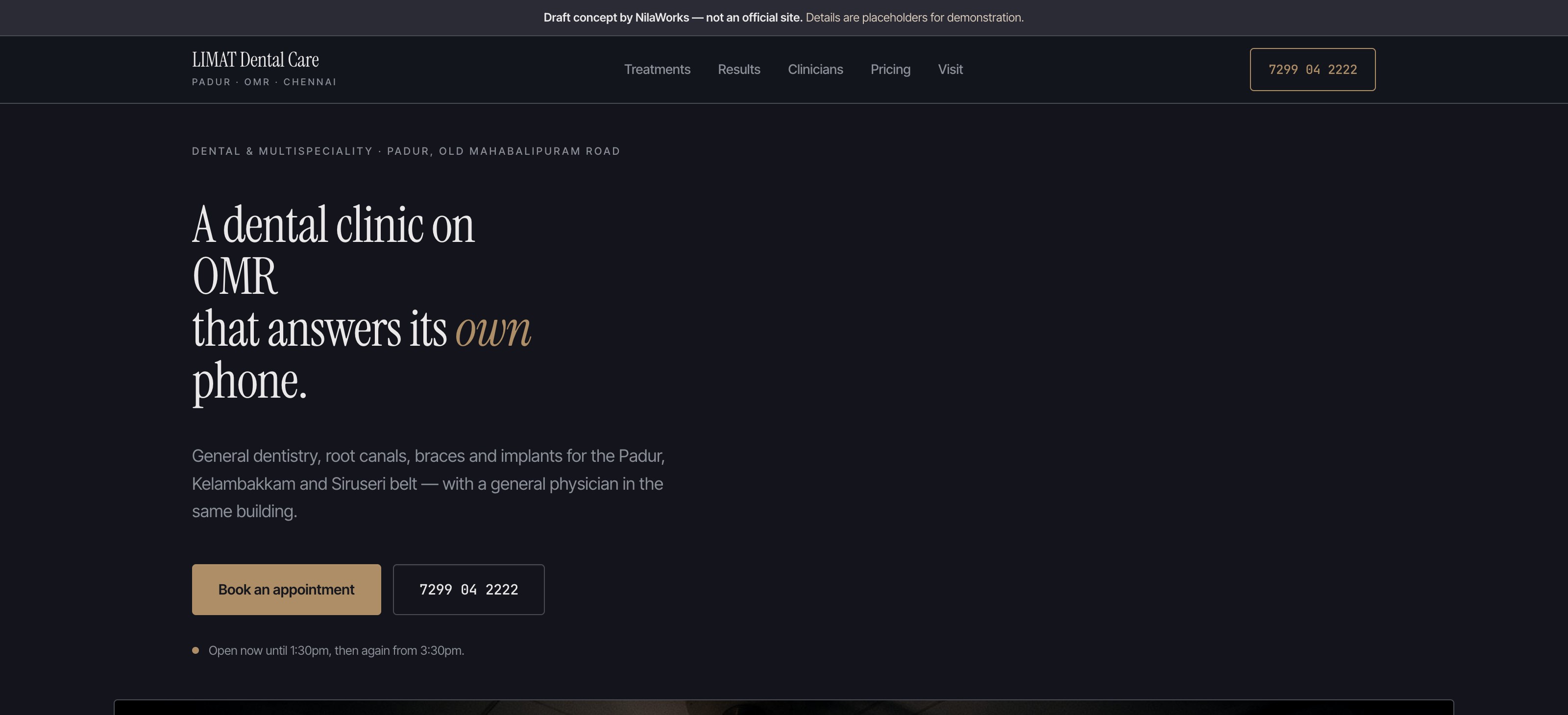
A clinic on a corridor full of new residents who search before they ask a neighbour. The problem: showing what the work looks like without overclaiming — a draggable before/after and a services slider in ink and bronze, results shown, outcomes never promised.
Open the concept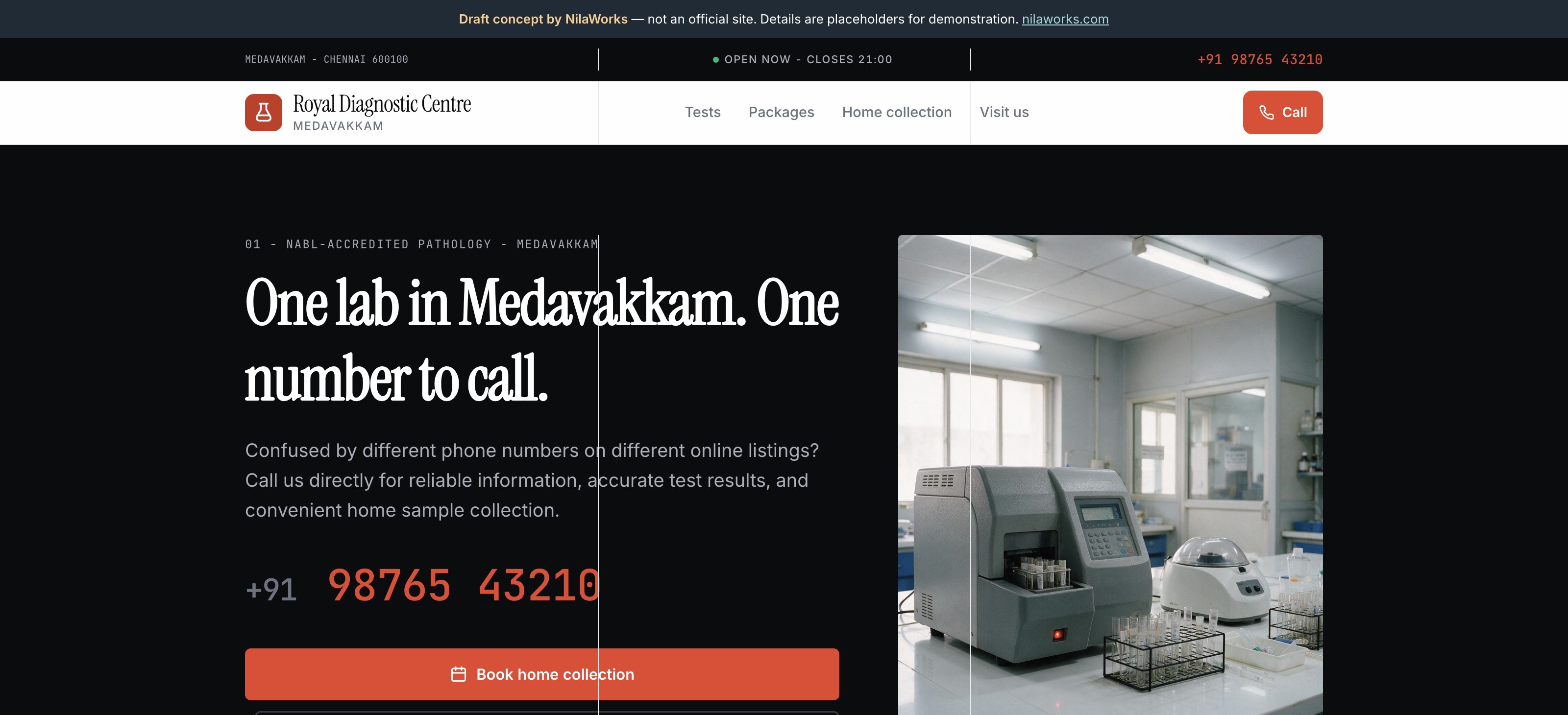
Six listings, five different phone numbers, one lab. The problem: fragmentation itself — so the page opens by making the confusion visible, then resolves it into a single number, a single address and a single place to book a test.
Open the concept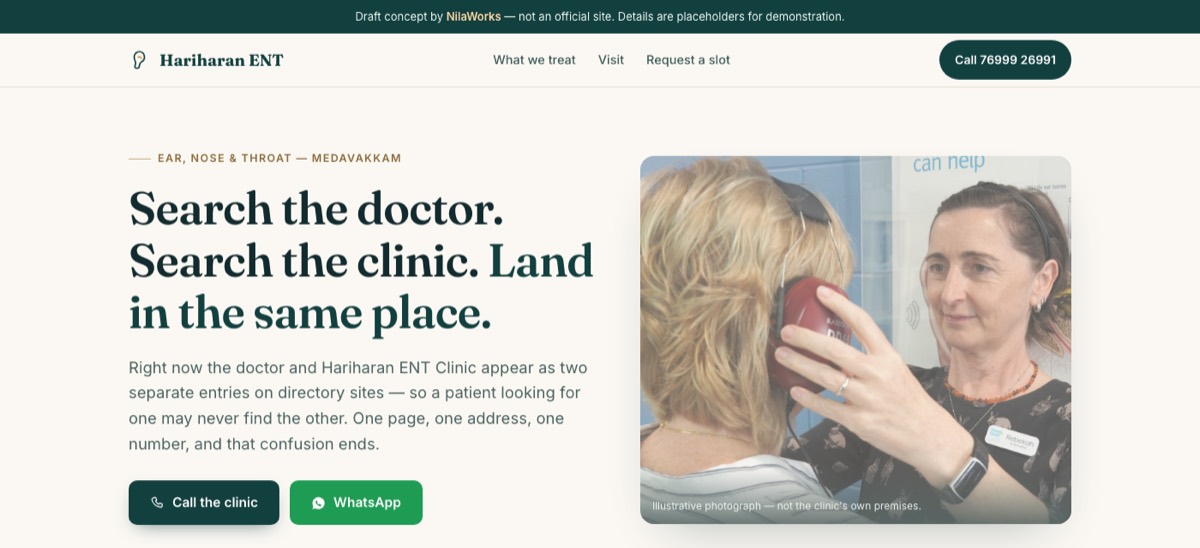
The doctor and the clinic were showing up as two separate entities across the directories. The problem: a patient searching either name should land in the same place — one page, one address, one number, and the split ends.
Open the conceptOne page that does the whole job: what you treat, who you are, timings, location, costs if you want them shown, and tap-to-call plus WhatsApp everywhere. Right for a single-doctor clinic or a lab that just needs to exist properly.
Start thisMulti-page: a page per treatment or test panel, a doctors page, a visit-and-directions page, an enquiry form and an FAQ. This is the one that actually ranks for “implants in Anna Nagar”, because each treatment finally gets a page of its own.
Start thisHosting, backups, security updates and unlimited small edits — new timings, a doctor joining, a price change, a camp announcement. Message us, it's live the same day. Entirely optional; the site is yours with or without it.
Ask about itYou own it outright. The domain is registered in the practice's name, the code and the content are yours, and you get the files. Cancel the Care Plan and nothing switches off — we hand over hosting and you carry on. No retainer traps, no “managed platform” you can never leave.
Prices are in Indian rupees and exclude the domain registration (about ₹900–1,200 a year, paid directly by you to the registrar, in your name). The first draft is free: you see the real page before any money changes hands.
Medical advertising in India is restrained by the NMC and Medical Council codes, and a website is advertising. A designer who doesn't know that will happily put a fabricated accreditation badge or a made-up success rate on your homepage — and it's your registration at risk, not theirs. We work the other way round.
Qualifications, registration numbers, years of experience, accreditations, equipment, what you do and don't treat — all of it comes from the practice in writing, and we publish it as given. If you can't source it, it doesn't go on the page.
No guarantees of outcome, no “best in Chennai”, no comparisons that put another practice down, no numbers dressed up as clinical evidence. Describing what you do well is allowed and effective. Promising results is neither.
No patient photograph, before/after image, scan or story goes online without the patient's written consent, which the practice holds. Where we've used photographs in our concept pages, they're stock and labelled as illustrative on the page itself.
Nothing clinical is published on a hunch. You read the treatment pages line by line and sign off. We'd rather delay a launch by a day than publish a sentence you'd have to defend.
Plainly: the responsibility for every medical claim sits with the practice, and our job is to make sure you're never asked to defend a claim you didn't make. We hold the same line on our own marketing — this studio has no healthcare clients yet, and you'll notice we haven't pretended otherwise anywhere on this page.
If yours isn't here, ask it directly — you'll get a real answer, not a sales call.
Ask on WhatsApp